- Oct 20, 2024
Violin Size Chart
- Meghan Faw
- 0 comments
Violins come in a variety of sizes, and picking the right one is a key factor to staying injury-free and enjoying the learning process. Playing on a violin that is too big increases the chance of injury (namely carpal tunnel and tendonitis) and playing on a violin that is too small can feel very cramped and limited in their fingering and bowing placements.
Why do violins come in different sizes?
Violins come in different sizes to accommodate the different sizes and ages of violin learners. Since it is common to start playing the violin at a young age, it makes sense to have small violins to fit the younger learners. The variety of sizes also means that smaller adults can find a violin that fits them comfortably rather than struggling to use a full size.
How many violin sizes are there?
There are nine violin sizes: full size (4/4), seven-eighths (7/8) three-quarters (3/4), one-half (1/2), one-quarter (1/4), one-eighth (1/8), one-tenth (1/10), one-sixteenth (1/16), and one-thirty-second (1/32).
How do I know what violin size I need?
Violin sizing is based around arm length. Age is also taken into consideration, but all children grow at different rates, and some adults are quite small, so violin sizing should always prioritize size rather than age. If you are in between sizes, choose the one that is smaller to prevent risk of injury.
Violin Size Chart
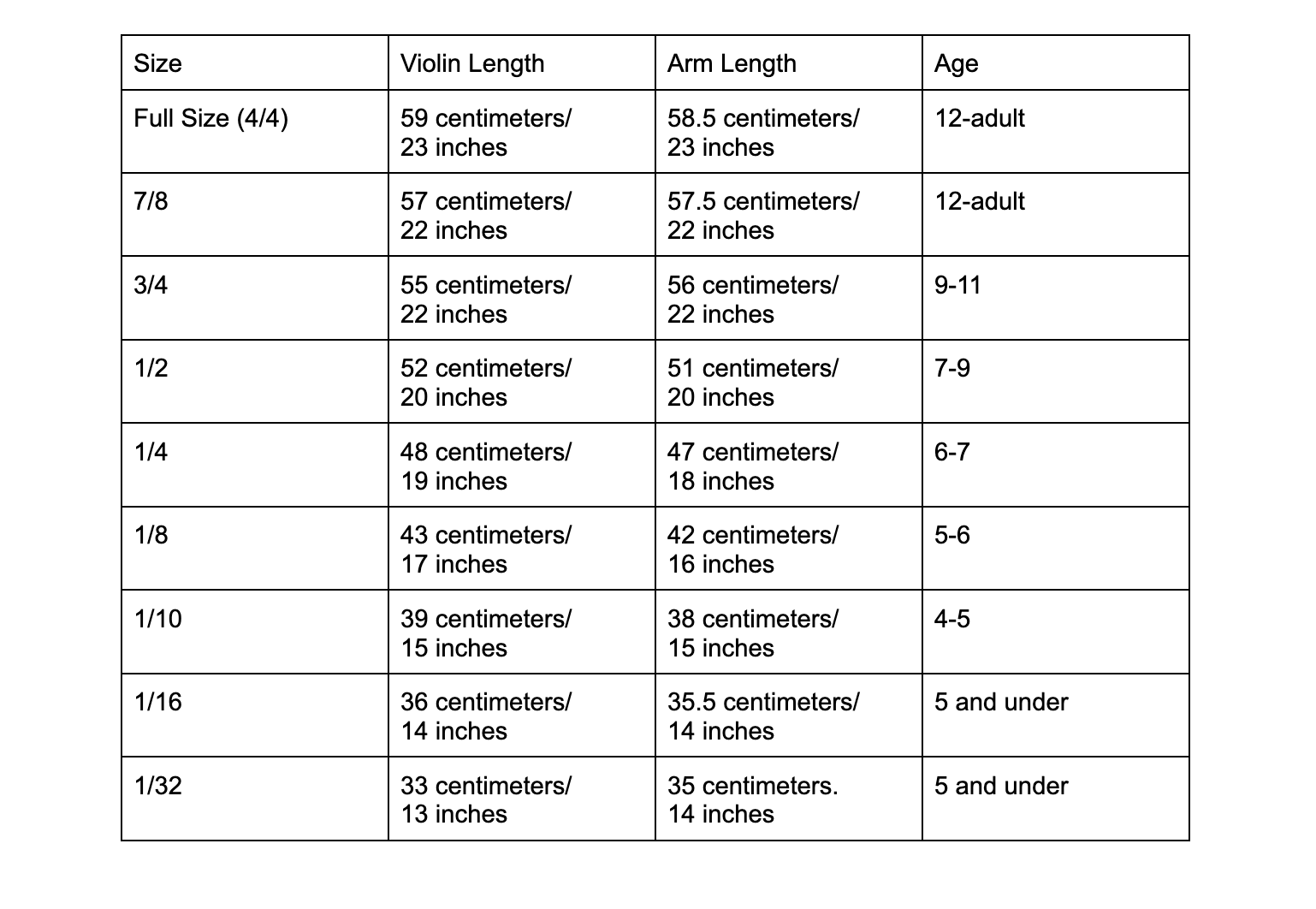
I'm a very small adult. Should I use a full size violin?
That depends. In my experience, people who are around 5 feet tall (60 inches) should be able to use a full size violin. However, some adults with short arms, fingers, and/or mobility issues may find it easier to play on a smaller instrument. 7/8 size violins are a great option, but they are hard to find. An important thing to keep in mind is that any fractional size violin (even 7/8) will not have as full or loud of a sound as a full size.
How do I measure myself to find my violin size?
There are two ways of measuring yourself (or your child) to see what violin size would suit you best.
-
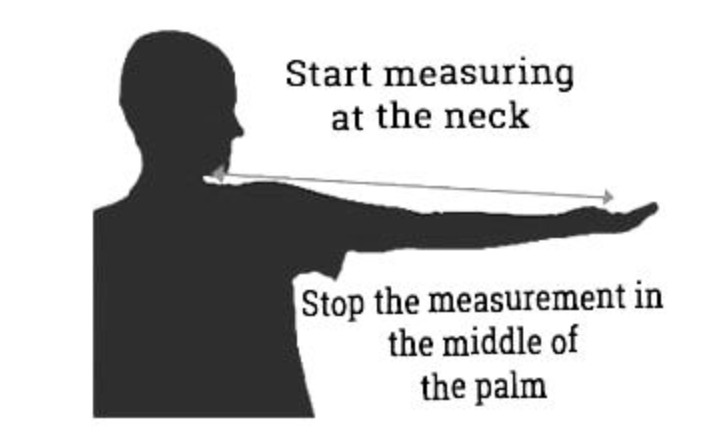
Place a tape measure at the nape of your neck and extend it to the middle of your left palm. When doing this, your arm should be held out straight so that it’s parallel to the ground. Once you have your measurement, you can use the chart here to determine which size would fit best.
-
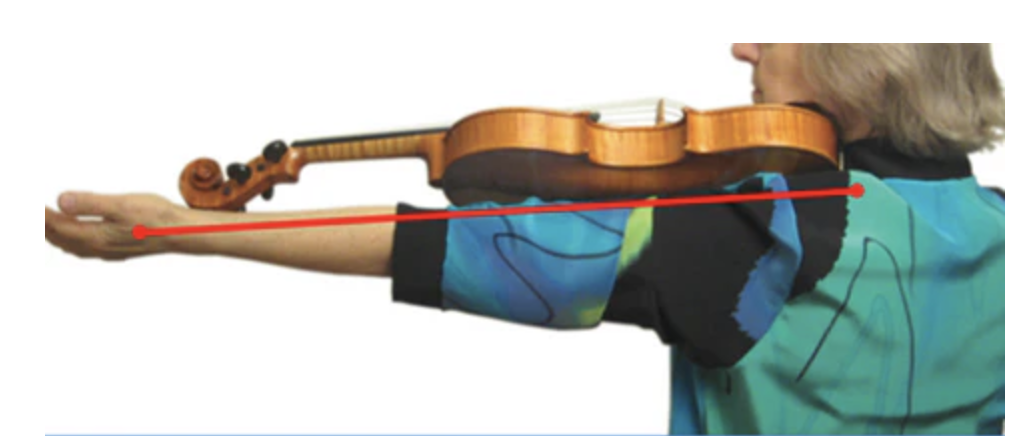
Place your violin on your left shoulder and extend your left arm out straight, parallel to the ground. The scroll of the violin should come in contact with your wrist. If the scroll sits at your palm, the instrument is too big, and if the scroll sits closer to your forearm, the instrument is too small.
-
Many violin shops are also happy to measure you if you need extra assistance or reassurance.
How do I know when I or my child need the next size?
If you notice that your child has had a growth spurt, it's likely that they'll need to move up to a bigger size! I've found that once children are using a 1/4 size violin, it usually takes about 1 year to 1.5 years to be ready for the next size up. If you notice that your child's elbow is bending more than normal when holding the violin (and therefore the arm is closer to the body), or bending their wrist and touching the side of the instrument, these are good indicators that they are ready for a larger violin size. You or your child's teacher will also be able to give advice on when it's time to move up to a bigger instrument.
When changing violin sizes, be aware that the new instrument will likely feel heavier, the bow will be longer, and that the spaces between the notes will be bigger. For the first few days or even weeks, I recommend playing scales and pieces you know well to get used to the change. You'll likely need to reevaluate your posture and finger placement.
Is it ok to skip a violin size?
Yes! It's perfectly fine to skip a violin size as long as it fits comfortably. There's no rule that says you must play every size of the violin! It's also ok to expect the child to grow into the new instrument as long as the difference is a sensible one.
What about the viola?
Although the violin and viola are similar, sizing is one big way in which they differ. The viola is generally bigger than the violin, and a “full size” viola can actually be a variety of sizes! Bigger violas are generally preferred because they give a deeper, richer sound. With that being said, being tall does not necessarily mean a bigger viola is for you, and being small does not necessarily mean a smaller viola is for you! When trying to find your optimal viola size, I highly recommend trying several options to see what feels (and sounds!) best.